- 1. Core AI System: One Model, Every Surface
- 3. Ask Gemini: Context Tools Anywhere
- 4. Conversational Search Bar
- 5. Personalization: Location + History
- 6. Connected Google Apps
- 7. Multimodal AI: Text, Image, Video, Audio
- 8. Cross-App Memory and Context
- 9. NotebookLM: Research AI
- 11. Share / Public Link Feature
- 12. Third-Party Apps and Extensions
- 13. AI Verification and Trust Layer
- The Final SEO Shift
- What This Means for Your Website
- Frequently Asked Questions
Search isn’t just a list of blue links anymore. Google has spent the last two years rebuilding nearly every surface — Search, Chrome, Android, Workspace — around one AI system: Gemini. For website owners and marketers, that’s not a minor update. It’s a shift in what “ranking well” even means.
This guide walks through Gemini’s core features in 2026 and breaks down exactly how each one is reshaping SEO.
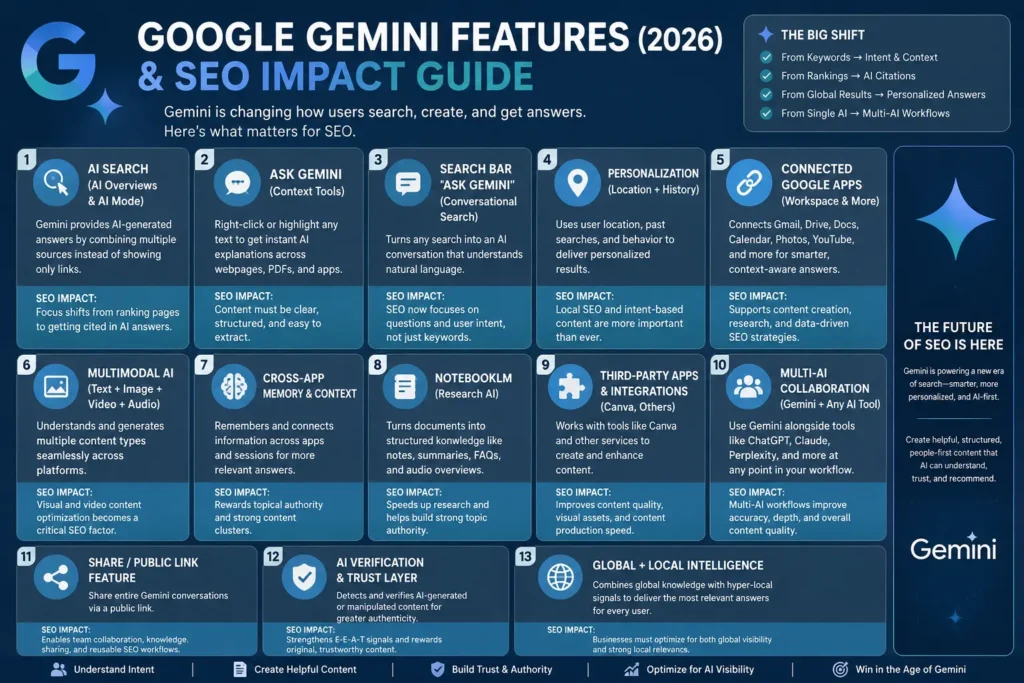
1. Core AI System: One Model, Every Surface
Gemini is Google’s foundational AI model, and instead of living in a single app, it now powers Search, Android, Chrome, and Workspace from the same underlying system. That means the AI evaluating your content in a search result is the same AI summarizing it in Chrome and surfacing it in a Workspace document.
SEO impact: Content is no longer judged only by traditional ranking signals like backlinks and keyword density. It’s also being read, summarized, and judged for trustworthiness by an AI system — which rewards clarity and factual accuracy in ways classic ranking factors don’t always capture.
2. AI Search: AI Overviews + AI Mode
This is the biggest shift for SEO. Google now answers many queries directly, instead of just pointing to ten links.
- AI Overviews sit at the top of standard search results, synthesizing an answer from multiple sources while still showing the traditional results below.
- AI Mode goes further — it’s a full conversational search experience that runs several searches behind the scenes to build one comprehensive answer, often without the familiar list of links at all.
SEO impact: The goal is shifting from “rank #1” to “get cited inside the AI answer.” Showing up in position one no longer guarantees a click if the AI Overview already answered the question above it.
3. Ask Gemini: Context Tools Anywhere
Gemini is now built into the browsing experience itself. Highlight a sentence on any webpage, right-click, and an “Ask Gemini” option explains it instantly — no copy-pasting into another tab required. The same works inside PDFs and other apps. Gemini 3.0 is the most advanced LLM Model.
SEO impact: Your content needs to hold up when it’s pulled out of context. If a single highlighted paragraph gets fed to an AI for an instant explanation, that paragraph needs to be clear and self-contained — not dependent on three preceding sentences to make sense.
4. Conversational Search Bar
The search box itself has changed. It now expands as you type, anticipates intent, and increasingly treats queries as natural-language questions rather than strings of keywords.
SEO impact: Keyword stuffing was already outdated, but this makes it worse. SEO now revolves around answering real questions in natural language — write for “how do I fix a slow laptop,” not “laptop slow fix.”
5. Personalization: Location + History
Gemini-powered search results increasingly factor in a user’s location, search history, and behavior patterns, meaning two people typing the same query can see different results.
SEO impact: Local SEO and intent-based optimization matter more than ever. A single “universal” ranking for a keyword is becoming less relevant — what matters is how well your content matches a specific user’s likely intent and location. Try Gemini 3.0.
6. Connected Google Apps
Gemini links into Gmail, Drive, Docs, Calendar, Photos, and YouTube, drawing on personal and workspace data to give smarter, more contextual answers.
SEO impact: This ecosystem connection is also a productivity layer for SEO work itself — content creation, keyword research, and reporting can pull from the same connected data, speeding up workflows.
7. Multimodal AI: Text, Image, Video, Audio
Gemini doesn’t just read text — it understands images, video, and audio together, and connects to tools like YouTube for video content. Grow with Google with a free course of AI for content creation.
SEO impact: SEO is no longer a text-only discipline. Image alt text, video transcripts, and audio content are all things AI systems now parse and can cite — meaning visual and video optimization is becoming a core SEO skill, not an afterthought.
8. Cross-App Memory and Context
Gemini retains context across apps and sessions, connecting information instead of treating each interaction as a blank slate.
SEO impact: This rewards topical authority. A site with a deep, interconnected cluster of content on a subject is easier for an AI system to recognize as a trustworthy source than a single standalone page — even if that page is well-optimized on its own.
9. NotebookLM: Research AI
NotebookLM turns raw documents into structured knowledge — notes, summaries, and FAQs generated from whatever you feed it.
SEO impact: It’s a genuine research accelerator. Feed it competitor content, customer reviews, or research papers, and it can speed up the process of building genuinely deep, well-organized topic authority instead of thin, surface-level posts.
10. Multi-AI Collaboration
Gemini doesn’t exist in isolation. Gemini can be used alongside any AI tool (ChatGPT, Claude, Perplexity, etc.) It doesn’t need a separate workflow — it can be added at any point in a task or chat Works as a real-time collaborator, not just a standalone tool Helps refine, re-check, or improve outputs while you’re already working in another AI. Many marketers now use it alongside tools like ChatGPT — comparing, refining, and combining outputs from multiple AI systems for a single piece of content.
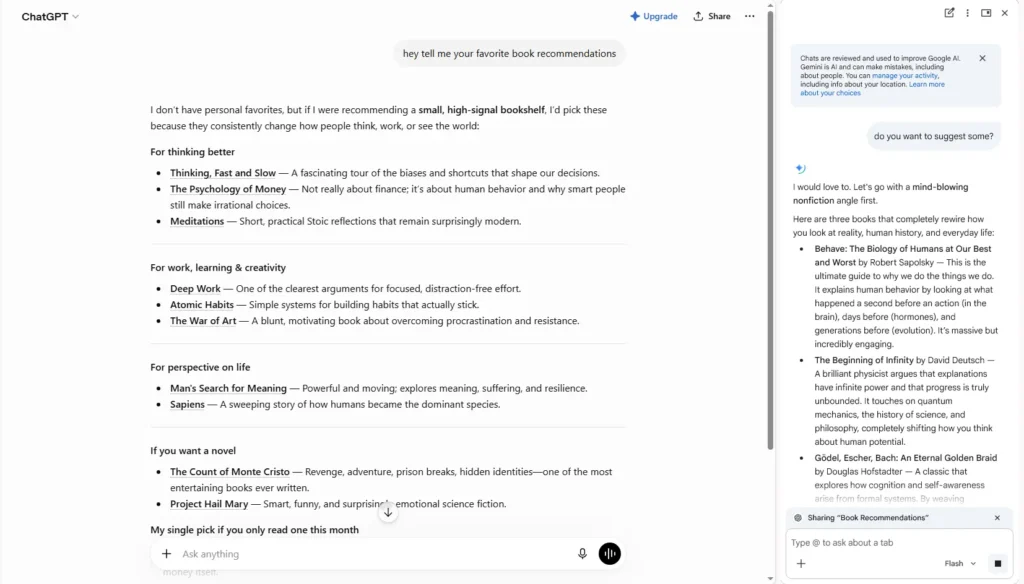
SEO impact: Content creation is becoming a multi-AI workflow rather than a single-tool process, generally raising the bar on quality since each tool can catch what another misses. Reduces errors and improves depth by cross-checking ideas instantly. Results in higher-quality, more refined SEO content through continuous AI collaboration
11. Share / Public Link Feature
Full Gemini conversations can be shared via a public link, making it easy to hand off research, drafts, or analysis to a teammate or client.
SEO impact: This simplifies collaboration and documentation — useful for building repeatable, reusable SEO workflows across a team.
12. Third-Party Apps and Extensions
Gemini integrates with external tools like Canva and various AI extensions, extending what it can directly produce.
SEO impact: Faster content production, especially for visual assets — which matters more now that visual SEO is part of the equation (see point 7).
13. AI Verification and Trust Layer
Google has built out a system to detect AI-generated or AI-edited content. It uses SynthID, an invisible watermark embedded in content created by Google’s own AI models, alongside Content Credentials, a metadata-based system that works like a digital passport for files. Together they’re rolling out across the Gemini app, Chrome, and Search, letting anyone check whether an image, video, audio clip, or piece of text was AI-generated.
SEO impact: As AI-generated content floods the web, signals of originality, authorship, and trust (the foundation of E-E-A-T) become more valuable, not less. Verification infrastructure like this raises the cost of low-effort, mass-produced AI content and rewards sites that can demonstrate real expertise and original work.
The Final SEO Shift
Pulling all of this together, four shifts define where SEO is heading:
- Keywords → Intent + Context. Matching a search term isn’t enough; content needs to answer the actual question behind it.
- Pages → AI-Cited Content. Ranking high doesn’t matter if an AI Overview answers the query before the user ever scrolls down — getting cited inside the answer is the new goal.
- Global Ranking → Personalized Results. Location, history, and behavior mean there’s no single “#1” anymore — there’s a #1 for each user.
- Single AI → Multi-AI Workflows. Content creation and research increasingly draw on more than one AI tool, raising the baseline for quality.
What This Means for Your Website
None of this means SEO is dying — it means it’s splitting into two connected goals: ranking in traditional results and earning a citation inside AI-generated answers. Practically, that means:
- Writing clear, self-contained sections that answer a specific question directly
- Building genuine topical depth instead of one-off pages
- Treating images, video, and audio as first-class SEO assets, not afterthoughts
- Backing content with real authorship and originality, since trust signals now carry real weight
The sites that adapt to this — writing for both human readers and AI systems reading on their behalf — are the ones that will stay visible as search keeps changing. Read about using Gemini for marketing.
Frequently Asked Questions
Find answers to commonly asked questions about Google Gemini.