You often hear people on social media talking about terms like SEO, AEO, and GEO. Some say SEO is dead, others claim AEO is the future, while many believe GEO is all you need to rank in AI search. With so much conflicting information online, it’s easy to get confused about what these terms actually mean.
In this article, we’ll break down what is Answer Engine Optimization (AEO), and Generative Engine Optimization (GEO), how each one works, how to optimize your content for them, and why they matter in today’s search landscape. By the end, you’ll understand the real differences between these strategies and how they work together to improve your visibility across Google Search, AI-powered search engines, and generative AI assistants.
What is Answer Engine Optimization (AEO)?
Answer Engine Optimization (AEO) is the practice of creating content that provides clear, direct, and factual answers to users’ questions. The goal is to help search engines extract a concise answer and display it without requiring users to read an entire page.
AEO is primarily associated with search features that present a single answer or a summarized response.
Examples include:
- Google AI Overviews (for many informational searches)
- Featured Snippets
- Voice search results through Google Assistant and Siri
- Bing Copilot responses
Rather than optimizing only for keywords, AEO focuses on answering search intent as clearly as possible.
What is Generative Engine Optimization (GEO)?
Generative Engine Optimization (GEO) is the process of optimizing content so that AI models can understand, trust, and reference it when generating responses.
Unlike AEO, which often targets a direct answer box, GEO aims to increase the chances that AI assistants use your content as part of a broader, synthesized response.
Examples of generative search platforms include:
- ChatGPT Search
- Google Gemini
- Perplexity AI
- Claude
- Microsoft Copilot
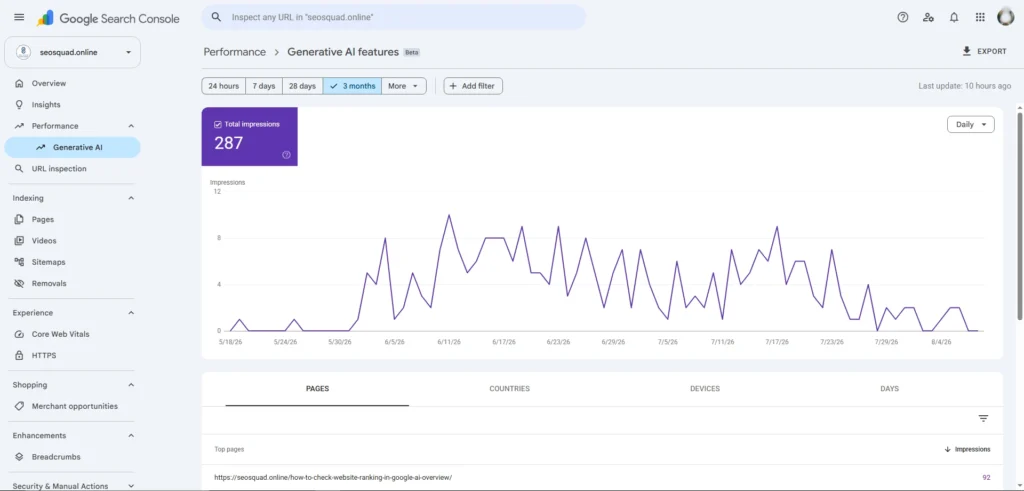
These systems rarely copy a webpage word for word. Instead, they combine information from multiple trusted sources to generate a complete answer. Because of this, GEO emphasizes authority, credibility, expertise, and comprehensive coverage of a topic. Google search console provides the Generative AI performance metrics of website.
AEO vs GEO: The Real Differences
Although both strategies aim to improve visibility in AI-driven search, they are not identical.
Primary Goal
AEO focuses on helping search engines deliver a quick, accurate answer.
GEO focuses on becoming a trusted source that AI models use while generating detailed responses.
Content Length
AEO often benefits from concise sections that answer one question clearly.
GEO usually performs better with comprehensive content that fully explains a topic while remaining easy to understand.
Content Structure
AEO favors definitions, FAQs, lists, and step-by-step answers because they are easy for search engines to extract.
GEO benefits from logical headings, detailed explanations, examples, comparisons, and supporting evidence that help AI understand the complete context.
Authority Requirements
AEO can succeed with a well-written article that answers a question effectively.
GEO generally favors websites that consistently publish reliable, original, and authoritative content across an entire topic.
Information Sources
AEO usually extracts answers directly from a single webpage.
Generative AI typically combines information from multiple trusted websites before producing a response.
Similarities Between AEO and GEO
Despite their differences, both approaches rely on many of the same SEO fundamentals. Successful content should:
- Match the user’s search intent.
- Demonstrate Experience, Expertise, Authoritativeness, and Trustworthiness (E-E-A-T).
- Use descriptive headings and logical organization.
- Be factually accurate.
- Stay updated as information changes.
- Offer real value instead of repeating information already available elsewhere.
Neither AEO nor GEO replaces traditional SEO. Instead, both build on strong SEO foundations.
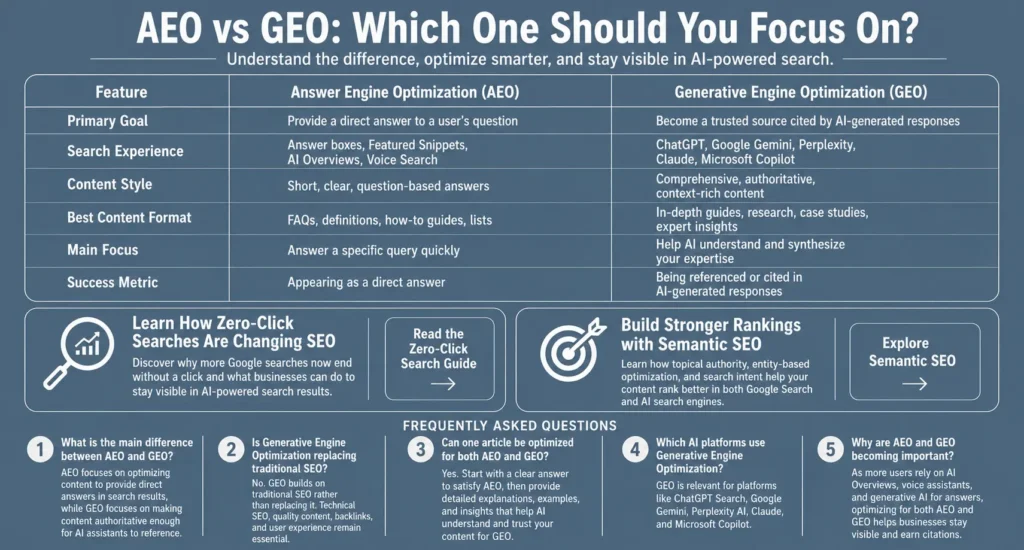
AEO vs GEO Comparison Table
| Feature | Answer Engine Optimization (AEO) | Generative Engine Optimization (GEO) |
|---|---|---|
| Primary Goal | Provide a direct answer to a user’s question | Become a trusted source cited by AI-generated responses |
| Search Experience | Answer boxes, Featured Snippets, AI Overviews, Voice Search | ChatGPT, Google Gemini, Perplexity, Claude, Microsoft Copilot |
| Content Style | Short, clear, question-based answers | Comprehensive, authoritative, context-rich content |
| Best Content Format | FAQs, definitions, how-to guides, lists | In-depth guides, research, case studies, expert insights |
| Main Focus | Answer a specific query quickly | Help AI understand and synthesize your expertise |
| Success Metric | Appearing as a direct answer | Being referenced or cited in AI-generated responses |
How to Optimize for AEO
AEO is largely about making answers easy for search engines to identify. Some practical methods include:
- Start important sections by answering the question directly before providing additional explanation.
- Use question-based headings that reflect how people naturally search.
- Create FAQ sections where appropriate instead of forcing them onto every page.
- Use structured data (Schema markup) when it accurately represents your content.
- Keep definitions simple and avoid unnecessary introductions before answering the question.
- Improve page speed, mobile usability, and accessibility, since technical SEO still influences visibility.
How to Optimize for GEO
Have a good generative engine optimization strategy by following the below points:
- Optimizing for generative AI requires more than simply adding keywords.
- Publish content that demonstrates genuine expertise instead of rewriting information from competitors.
- Cover topics in depth so AI systems can understand the complete context rather than isolated facts.
- Support claims with statistics, research, examples, or firsthand experience whenever possible.
- Keep articles updated so outdated information is less likely to be referenced.
- Build topical authority by publishing multiple high-quality articles around the same subject instead of relying on one large guide.
- Earn mentions, backlinks, and citations from reputable websites, as these contribute to your site’s overall credibility.
- Develop a recognizable brand. AI systems are more likely to reference organizations that consistently publish reliable information.
Can You Optimize for Both AEO and GEO?
Yes—and in most cases, you should. A practical approach is to begin each section with a concise answer that satisfies AEO, then expand on the topic with examples, explanations, and supporting details that strengthen GEO.
For example, if someone searches “What is Generative Engine Optimization?”, the page should first provide a one- or two-sentence definition. After that, it can explain how GEO works, why it matters, real-world examples, common mistakes, and best practices. This structure serves both search engines looking for direct answers and AI systems generating comprehensive responses.
Common Mistakes to Avoid
Many websites make assumptions about AI optimization that are not supported by evidence.
- Avoid creating dozens of thin articles solely targeting AI search.
- Do not rely entirely on AI-generated content without reviewing and improving it.
- Avoid keyword stuffing or repeating the same phrase unnaturally.
- Don’t publish outdated information and expect AI systems to continue referencing it.
- Avoid making unsupported claims without evidence or credible sources.
Key point: Most importantly, don’t treat GEO as an entirely new replacement for SEO. High-quality technical SEO, helpful content, and strong website authority remain essential.
The Future of Search
AI-powered search will continue to evolve, but one principle is unlikely to change: search engines and AI assistants aim to provide users with the most accurate, trustworthy, and useful information available. Businesses that focus on publishing original, well-researched, and genuinely helpful content are far more likely to succeed than those trying to exploit short-term optimization tactics.
Instead of choosing between AEO and GEO, organizations should view them as complementary strategies. AEO helps your content answer questions quickly, while GEO increases the likelihood that AI assistants understand, trust, and reference your expertise.
Conclusion
Answer Engine Optimization and Generative Engine Optimization are closely related but serve different purposes. AEO focuses on helping search engines deliver direct answers, while GEO focuses on making your content valuable enough for AI systems to incorporate into generated responses.
The strongest long-term strategy is not to optimize exclusively for one or the other. Build technically sound websites, publish accurate and original content, organize information clearly, and consistently demonstrate expertise. These fundamentals support traditional SEO, improve AEO performance, and strengthen your visibility in generative AI search.