- What is a Content Audit for AI Overview
- Why Conduct a Content Marketing Audit
- Step 2: Check If the Keyword Triggers an AI Overview
- Step 3: Analyze Content Structure (Core Audit Step)
- Step 4: Audit for AI Citation Potential
- Step 5: Improve Content Depth & Topical Coverage
- Step 7: Recheck & Track AI Visibility
- Content Audit Checklist
- Common Content Audit Mistakes
- Final Takeaway
- FAQ: Content Audits & Google AI Overviews
If you want your website to be cited in Google AI Overview, just ranking on page one isn’t enough. AI systems don’t reward keywords or backlinks alone — they look for content that is clear, structured, and ready for AI to extract.
That’s where a content audit comes in with zero-click searches. By systematically reviewing your pages, you can identify content gaps, improve clarity, and optimize content for Google AI Overview citations. A proper audit ensures your articles are not just seen, but used directly by AI to answer user queries, including zero-click content opportunities.
In this guide, we’ll show you how to audit your website content, enhance AI citation potential, and make your pages more visible in Google AI Overviews in 2026.
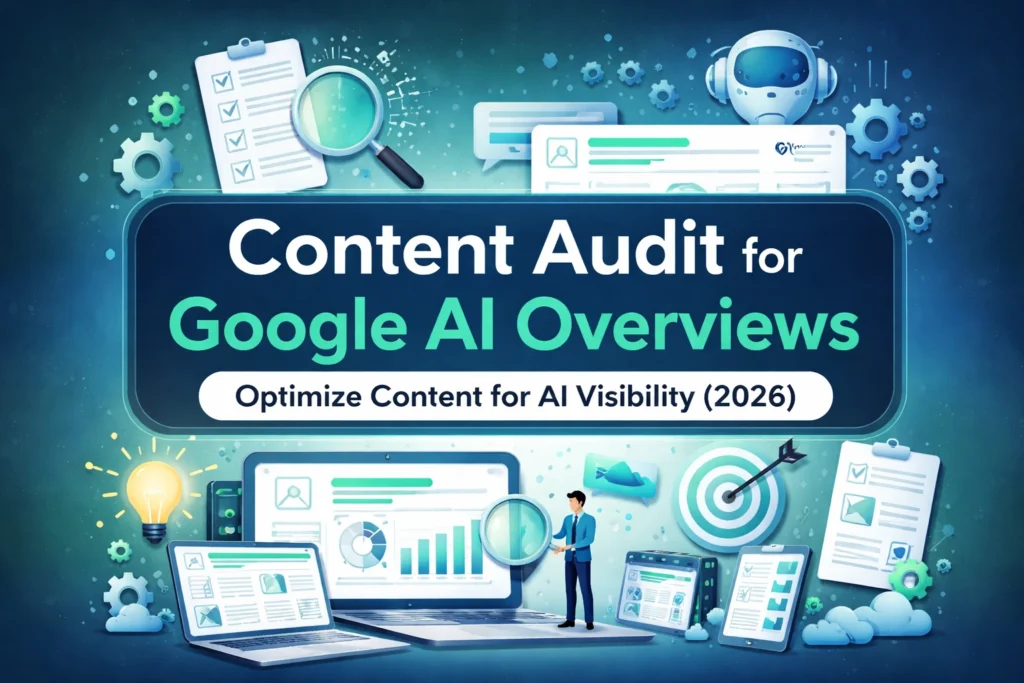
What is a Content Audit for AI Overview
A content audit is a systematic review of your website content to evaluate performance, relevance, and AI citation potential. Unlike traditional audits that focus on keywords, rankings, or backlinks, an AI-focused content audit examines whether your content is:
- Answering user queries clearly and directly
- Structured with headings, short paragraphs, and bullet points for easy scanning
- Authoritative, complete, and ready for AI extraction
- Optimized to provide zero-click answers when possible
Without these elements, AI systems are unlikely to reference your content — no matter how well it ranks in traditional search.
Why Conduct a Content Marketing Audit
Even top-ranking pages can be invisible to AI. Google AI Overviews favor content that is structured, factual, and easy to summarize. Conducting a content marketing audit helps you:
- Identify pages with AI citation potential
- Spot gaps where competitors are being referenced
- Discover opportunities to optimize content for Google AI Overview
- Pinpoint content that can be transformed into zero-click content
In short, a content marketing audit gives you a realistic picture of your AI visibility, showing where your content succeeds, where it is overlooked, and what you can do to optimize content for Google AI Overviews effectively. Try free content auditing tools to improve your blogs.
Step 1: Find Pages That Need Optimization
Start your content audit by identifying the pages that offer the most quick-win opportunities. Use Google Search Console to find:
- Pages with high impressions but low CTR
- Pages that rank well but aren’t cited in AI Overviews
- Informational content, long-tail keywords, and blog posts
Focusing on these pages means you can optimize existing content to become AI-citation ready without creating new content from scratch. Quick wins like these often show faster improvements in AI visibility.
Tip: Prioritize pages that already attract traffic — they have higher potential to be featured as zero-click content in AI summaries.
Step 2: Check If the Keyword Triggers an AI Overview
Next, verify whether your target keyword actually triggers an AI Overview.
- Open a browser in Incognito mode to avoid personalized results.
- Search the keyword and observe:
- Does an AI Overview appear?
- Which websites are cited?
- Is your content included?
If competitors are being cited but your content isn’t, it’s a strong signal that optimization is needed. If no AI Overview appears, that keyword may not be relevant for AI-focused optimization — consider targeting other informational or long-tail keywords.
Step 3: Analyze Content Structure (Core Audit Step)
Content structure is critical for AI citation. AI systems prefer well-organized, easy-to-scan content.
Check that:
- Headings (H2, H3) are used consistently
- Sections are clearly defined and focused
- Answers are direct and concise
Long paragraphs or vague explanations make it hard for AI to extract information. Improving structure often immediately increases your content’s AI citation potential.
Tip: Use numbered lists, bullet points, and short paragraphs to make content AI-friendly and reader-friendly.
Step 4: Audit for AI Citation Potential
Ask yourself: Can this content be summarized in 2–3 clear sentences?
If not, it needs adjustment. Improve AI citation potential by:
- Adding clear definitions and explanations
- Providing step-by-step instructions
- Creating short answer blocks for FAQs
AI Overviews prefer content that is simple, direct, and actionable, so clarity and conciseness are key.
Tip: Think like AI — if a machine had to skim content, so write summarized clear zero-click answers for readers.
Step 5: Improve Content Depth & Topical Coverage
AI systems favor comprehensive content. Shallow or partial coverage is rarely cited. During your audit:
- Check for missing subtopics
- Compare your content with competitors
- Ensure your content is detailed but structured
You can improve coverage by expanding sections, adding relevant examples, linking related content, and creating topic clusters. Comprehensive content signals authority and increases the likelihood of being referenced in AI summaries.
Step 6: Optimize Content for Google AI Overview
Once your content is structured and complete, focus on active optimization:
- Use bullet points, numbered lists, and tables for easy scanning
- Include FAQ sections addressing common questions
- Provide examples, statistics, and visuals
- Adopt an answer-first approach — each section should directly address a specific query
This approach ensures your content is easy for AI to extract and more likely to be cited in Google AI Overviews.
Tip: Prioritize clarity and readability over keyword stuffing — AI favors content that provides instant value.
Step 7: Recheck & Track AI Visibility
After updating your content, monitor the impact:
- Search your keywords in Incognito mode to see if your content appears in AI Overviews
- Use Google Search Console to track impressions, CTR, and traffic changes
- Maintain a weekly tracking sheet to identify patterns and improvements
Regular monitoring helps you understand what’s working and where further content optimization is needed, keeping your content AI-ready and citation-worthy.
Content Audit Checklist
Use this practical checklist to quickly evaluate your content for AI visibility and citation potential:
| Checkpoint | Status / Notes |
|---|---|
| AI Overview appears for the target keyword | Yes / No / Needs Optimization |
| Content has a clear and logical structure | ✅ / ❌ |
| Direct, concise answers are provided | ✅ / ❌ |
| Topic coverage is complete (subtopics included) | ✅ / ❌ |
| Competitor content analyzed for comparison | ✅ / ❌ |
| Content optimized for AI extraction and zero-click answers | ✅ / ❌ |
Tip: Track this sheet weekly to monitor improvements and see which pages are becoming more AI-friendly over time.
Common Content Audit Mistakes
During a content audit, many website owners make avoidable errors that limit AI citation potential:
- Focusing solely on keywords instead of structure and clarity
- Ignoring whether an AI Overview actually appears for the target keyword
- Skipping competitor analysis to see why they are cited instead
- Making changes without tracking performance (impressions, CTR, AI visibility)
Avoiding these mistakes ensures your audit is accurate, actionable, and effective. You can explore the seo audit checklist too.
Final Takeaway
A content audit is no longer optional — it is the foundation for AI search optimization. Without auditing, you can’t know:
- What content is working
- What content is being overlooked
- What needs further improvement
With a proper website content optimization, you can systematically:
- Improve structure for better AI readability
- Enhance clarity for quick extraction and zero-click answers
- Increase your chances of being cited in Google AI Overviews
Remember: Optimizing content for AI visibility isn’t just about ranking — it’s about being seen, cited, and trusted by Google’s AI systems.
FAQ: Content Audits & Google AI Overviews
SEO Squad answers your queries about content optimization for Google AI Overview.