Picture this: you ask your phone a question—“What is AI search optimization” or “What’s the best strategy for AI visibility in 2025?”—and within seconds, an AI assistant gives you a complete answer. No scrolling. No blue links. No ten-page chase for context.
That’s the new reality. People don’t search the same way anymore—they converse. And while the world of SEO once revolved around rankings, backlinks, and keywords, we’re now entering a world where visibility means being chosen by AI.
This transformation isn’t theoretical—it’s already happening.
According to PYMNTS, AI-powered search traffic in the U.S. now accounts for over 5.6% of desktop searches. It has more than doubled in the past year
And globally, 67 % of organisations are already integrating large language models (LLMs) into their digital workflows for generative optimization.
So if your website still plays by 2018 SEO rules, you’re not just behind—you’re invisible to the new AI layer that decides what gets seen and who gets cited.
What’s Changing — From Search to “Sense-Making”
Traditional search engines used to rely on index-based retrieval—matching typed keywords to pages. But today’s AI-driven systems, powered by models like GPT-5, Gemini, and Claude, are doing something much more advanced: semantic synthesis.
Instead of merely listing pages, AI engines interpret, summarise, and combine insights from multiple sources to deliver one cohesive response.
That means your content must now speak the language of LLMs—clear, structured, credible, and context-rich.
A 2025 report from CMSWire explains that AI Search Optimization (AISO) isn’t about abandoning SEO—it’s about expanding it:
“AISO ensures that your brand’s content is recognised, understood, and cited by AI systems—not just ranked by algorithms.”
What is AI Search Optimization (AISO)?
So your question, what is AI Search Optimization?
It’s the practice of preparing your content so that AI-powered search engines and generative systems—like ChatGPT, Perplexity, and Google’s AI Overviews—can locate, interpret, and credit it within their responses.
Unlike traditional SEO, where “ranking” was the win condition, AISO’s goal is to be the cited source when an AI system generates an answer.
Let’s break it down simply:
| SEO (Then) | AISO (Now) |
|---|---|
| Focused on keyword ranking | Focused on being cited by AI answer engines |
| Link-based authority | Semantic & contextual authority |
| Human click-through metrics | Machine interpretation and citation signals |
| Search result pages (SERPs) | Conversational responses via LLMs |
As Search Engine Land points out, AI is reshaping SEO in 2025 by blending technical precision with contextual trustworthiness—rewarding brands that are both helpful and reliable.
Why It Matters Right Now
Here’s what makes this shift urgent:
- AI search adoption is accelerating fast. Over 50 % of developers now use AI tools daily.
- Consumers trust generative search. Users are 30–40 % more likely to accept an AI-summarised answer as final than to click multiple links.
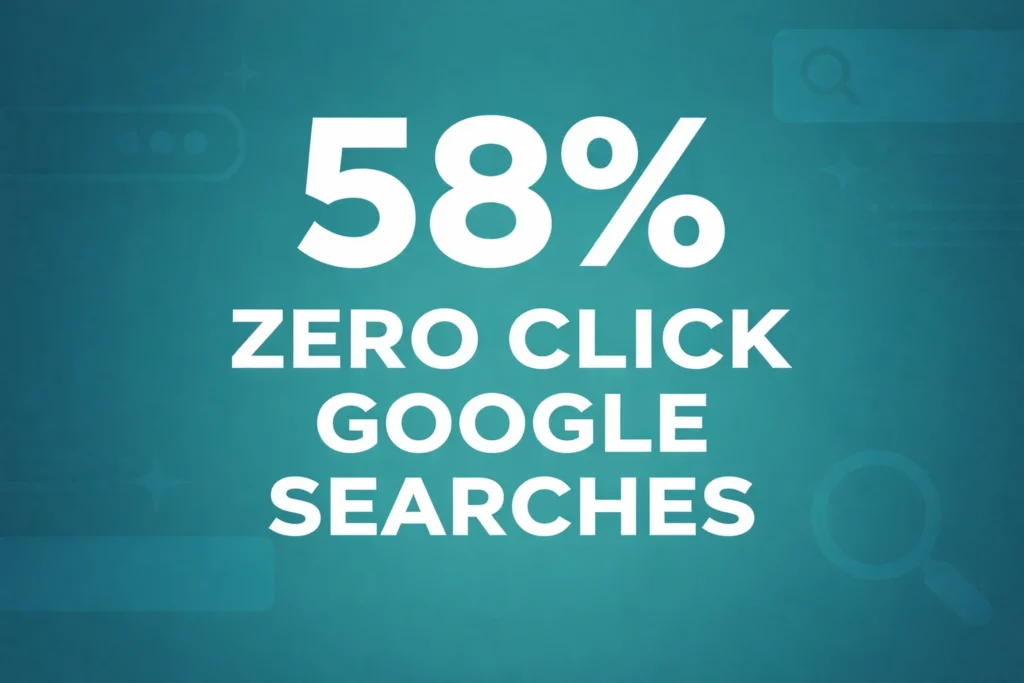
- Zero-click searches are rising. Over half of all searches in 2025 now end without a site visit—because the AI already answered it.
If your content isn’t optimised for this new layer, your brand risks disappearing from the “conversation layer” of search entirely.
The Shift from Keywords to Context
Keyword density once ruled SEO strategy. Now, intent density does.
AI systems like ChatGPT don’t rank “who says it best” — they select “who explains it most clearly.”
To align with this, your content should:
- Answer real-world questions conversationally.
- Use natural language, synonyms, and topic clusters.
- Add schema markup for structured comprehension.
According to InfoTrust, “well-structured, context-rich content has a 60 % higher chance of being used in AI-generated summaries”.
That means your job isn’t just to rank—it’s to be understood.
How to Implement AI Search Optimization (AISO)
Now that we understand the “why,” it’s time for the “how.”
Optimizing for AI search means training your website to speak the language of LLMs — structured, credible, and semantically rich. Below is your AISO playbook.
1. Optimize for Intent, Not Just Keywords
AI systems are trained to interpret meaning, not just match text. This means your content needs to address intentional queries — the “why” behind the question.
What to do:
- Write like you’re answering a human’s spoken question.
- Use question-based headings (e.g., “How does AI search differ from SEO?”).
- Add FAQs to every main page — they’re perfect training data for AI crawlers.
According to Exploding Topics (2025), pages that use natural question phrasing and semantic markup see 32 % higher AI citation rates in Perplexity and ChatGPT-style search engines.
2. Add Structured Data & Schema
AI systems rely heavily on structured data to understand web context. Schema markup (FAQ, HowTo, Review, etc.) makes your site’s data machine-readable — meaning it’s easier for AI to extract and cite your content.
What to do:
- Add FAQ, HowTo, and Article schema.
- Use JSON-LD format for better machine comprehension.
- Keep metadata (titles/descriptions) conversational but concise.
Search Engine Journal reports that sites with schema-rich structures are 2.7x more likely to appear in AI summary citations.
3. Build Topical Authority & Trust
In the LLM age, trust is the new ranking factor. AI models cross-verify facts before citing a source — meaning sites with consistent, expert-level content have higher visibility.
What to do:
- Publish long-form insights or original data (e.g., “AI Visibility Benchmarks 2025”).
- Reference credible external data sources.
- Earn backlinks from trusted domains — but quality over quantity.
According to Search Engine Land (2025), “AI now prefers brand-authenticated content, using citation consistency as a reliability signal”.
4. Craft Content for Multi-Modal Search
Generative search is moving beyond text — incorporating voice, visuals, and video insights. To future-proof, your content must be multi-format ready.
What to do:
- Add descriptive alt-texts and video transcripts.
- Create concise summaries at the top of articles.
- Repurpose written blogs into short-form video explainers.
Digital Silk (2025) reported that around 32% of consumers now use voice search daily, highlighting how conversational AI tools like Siri, Alexa, and ChatGPT Voice are changing the way people search online.
Table: Core Pillars of AI Search Optimization
| Pillar | What It Means | Why It Matters in 2025 | Action Step |
|---|---|---|---|
| Content & Context | Writing that answers questions clearly, not keyword stuffing. | LLMs prioritise clarity and conversational tone. | Audit all pages: make top paragraphs “answer-driven.” |
| Technical & Structure | Schema, structured data, and crawlable site setup. | Helps AI models extract meaning accurately. | Implement FAQ & HowTo schema; fix metadata gaps. |
| Authority & Citation | Building brand trust via consistent, verified insights. | AI search relies on “citation consistency.” | Publish data-driven posts; secure reputable backlinks. |
| Semantic Intent Alignment | Covering related topics in clusters, not isolated posts. | AI measures topical depth, not word density. | Link between subtopics (e.g., AI SEO → AI Content → LLM Strategy). |
| Multi-Modal Optimization | Visuals, voice, and short summaries. | Search behaviour is multi-channel. | Add summaries, transcripts, and alt tags. |
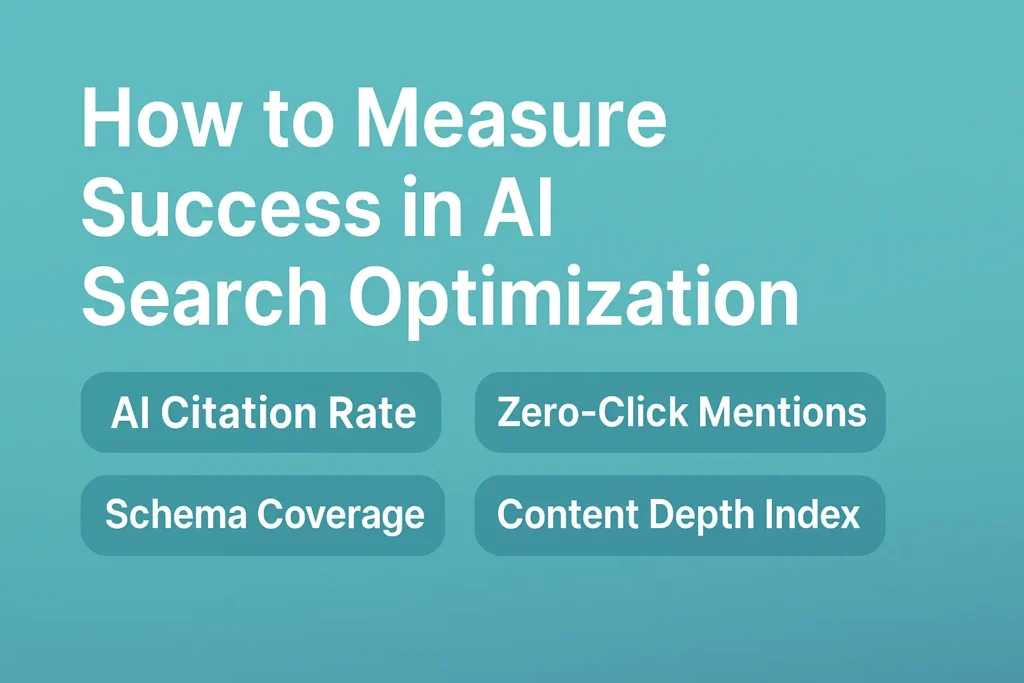
How to Measure Success in AI Search Optimization
AISO success metrics are different from traditional SEO. Don’t just track clicks—track citations and AI visibility signals.
Metrics to Track for AI Search Optimization:
- AI Citation Rate
- Indicates how often AI models (like ChatGPT or Perplexity) reference your brand or content.
- Tools to track: ChatGPT & Perplexity brand queries, manual audits.
- Indicates how often AI models (like ChatGPT or Perplexity) reference your brand or content.
- Zero-Click Mentions
- Shows visibility in AI-generated snippets without site visits.
- Tools to track: Google Search Console → check “Impressions” vs. “Clicks.”
- Shows visibility in AI-generated snippets without site visits.
- Schema Coverage
- Measures how much of your content is machine-readable.
- Tools to track: Google’s Structured Data Testing Tool.
- Measures how much of your content is machine-readable.
- Content Depth Index
Questions About AI Search Optimization Answered by SEO Squad
Closing Thought
Search is no longer about where you rank — it’s about what you represent.
If your brand’s knowledge doesn’t surface in AI-driven results, you don’t just lose traffic—you lose trust.
So don’t chase algorithms. Train them to find you.
That’s the power of AI Search Optimization — and that’s what SEOSquad helps you master.