- Why Google Produces So Many Zero Click Results
- Zero-Click Searches Still Create Real Impact
- The 80/20 Rule Applied to Zero-Click Search
- What Zero-Click Searches Signal About Search Behavior
- Table: How Zero-Click Searches Have Changed Search Outcomes
- Conclusion: Visibility in a Zero-Click Search World
- FAQs About Zero-Click Searches
Search behavior has quietly but fundamentally changed. Today, users search to get answers—not to browse websites. Increasingly, those answers appear instantly on Google’s results page, powered by AI summaries, featured snippets, and rich SERP elements.
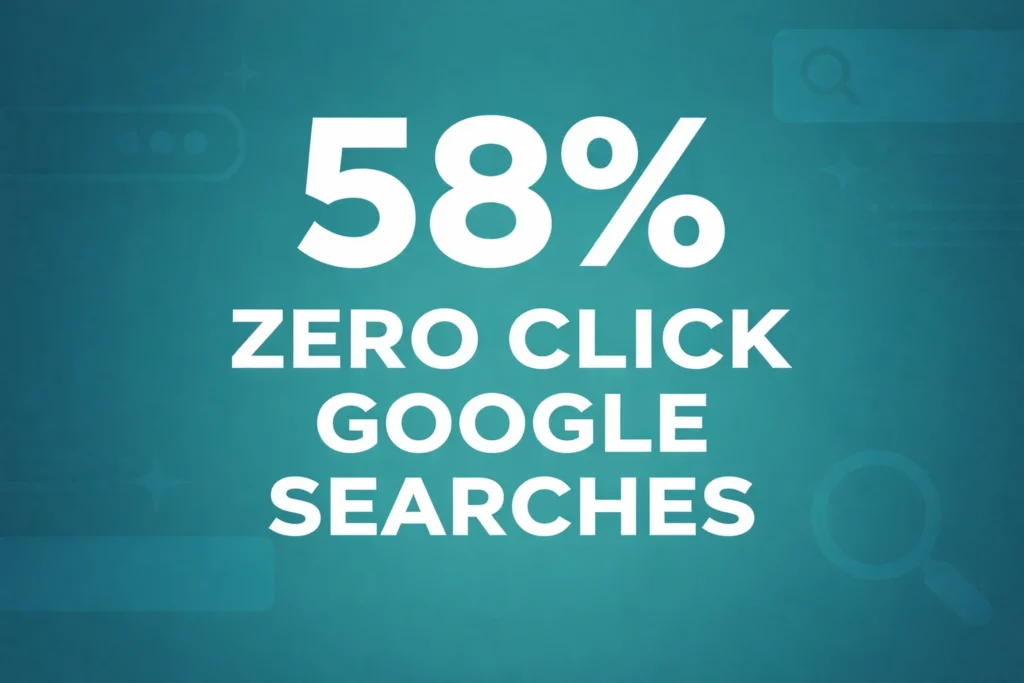
58% of Google searches now result in zero clicks to external websites citied by authoritative source.
This is why zero-click searches are rising at scale. In many cases, the search journey now ends the moment the result appears. No click. No session. Just an answer.
This shift is not speculative—it’s backed by data, and it’s reshaping how visibility works in modern search.
Zero-Click Searches Are Now the Default
Recent research shows that more than half of Google searches result in no click at all.
SparkToro’s large-scale analysis found that in the United States, only 374 out of every 1,000 Google searches lead to a click on the open web, meaning over 58% of searches end without any website visit.
Independent reporting confirms similar numbers, with estimates ranging between 58% and 60% zero click results, depending on location and device type.
Zero-click searches are no longer a trend—they are the dominant search behavior.
Why Google Produces So Many Zero Click Results
Google’s priority has shifted from directing users outward to resolving intent as fast as possible.
Zero click results are increasingly driven by:
- AI-generated summaries
- Featured snippets
- Knowledge panels
- Direct answers such as definitions, calculations, and comparisons
These formats reduce friction. When the answer is clear, Google has little incentive to send the user elsewhere. This is why informational queries—especially what, why, and how searches—are most affected.
As Google’s AI improves its understanding of intent, zero-click searches naturally increase.
Generative Engine Behind the Zero-Click Shift
The rise of AI-powered generative search experiences has accelerated zero-click behavior dramatically.
AI systems now:
- Combine information from multiple sources
- Summarize complex topics in seconds
- Present answers with high confidence
For users, this feels efficient. For brands, it means visibility increasingly happens without a click.
This is where AI search engine optimization becomes inseparable from zero-click searches. Visibility is no longer just about ranking—it’s about whether AI systems select your content to generate a zero click result.
Zero-Click Searches Still Create Real Impact
A common misconception is that if users don’t click, the content has failed. In reality, zero-click searches still deliver value—just not in traditional analytics.
When a brand:
- Appears in an AI summary
- Influences a zero click result
- Owns the explanation shown on the SERP
It still builds awareness, authority, and trust. The interaction simply happens earlier in the journey.
Industry analysis confirms that no click does not mean no impact—visibility still shapes perception and future decisions.
The 80/20 Rule Applied to Zero-Click Search
This is where the Pareto Principle (80/20 rule) becomes critical in a zero-click search environment.
The principle states that 20% of efforts drive 80% of results. In search, this means a small number of pages, queries, and topics generate the majority of visibility.
With zero-click searches, this matters even more.
Instead of optimizing everything, brands should focus on:
- Queries that trigger AI summaries
- High-intent informational topics
- Pages most likely to become zero click results
This approach maximizes visibility while minimizing wasted effort—especially when clicks are no longer guaranteed (Learn more here: Intergrowth – The Pareto Principle of SEO.
.
What Zero-Click Searches Signal About Search Behavior
The rise of zero-click searches does not mean users have lost interest in websites. It means they increasingly trust Google to answer questions for them.
Google is now acting as:
- A filter
- A summarizer
- A decision-maker
Content no longer competes page vs page—it competes source vs source inside an AI system. This is why AI search optimization is no longer optional.
How AI Search Engine Optimization Fits Into Zero-Click Search
Traditional SEO was built for a model where users clicked to evaluate options. Zero-click searches break that assumption.
AI search engine optimization focuses on ensuring content is:
- Easily understood by AI
- Structurally extractable
- Authoritative enough to be reused
AI systems don’t “read” content like humans. They evaluate clarity, topical focus, structure, and trust signals. Content that is bloated, vague, or unfocused is far less likely to appear in zero click results by generative engine optimization—even if it ranks.
Table: How Zero-Click Searches Have Changed Search Outcomes
| Search Behavior (Before) SEO | Search Behavior (Now) AISO |
|---|---|
| User clicks to explore answers | User gets answers directly on SERP |
| Rankings drive traffic | AI summaries drive visibility |
| SEO success = sessions (Google pages) | SEO success = presence in zero click results |
| Content optimized for users | Content optimized for users + AI systems |
| Click-through rate is primary KPI | Impressions, inclusion, authority matter |
This shift is directly tied to AI-driven SERP features and explains why AI search engine optimization is now inseparable from zero-click searches.
Why Success Metrics Must Evolve
Zero-click searches reduce visible traffic metrics such as:
- Sessions
- CTR
- Pageviews
But they increase:
- Impressions
- SERP presence
- Brand authority
Multiple studies show that zero click behavior reflects shifted value, not lost value.
AI search engine optimization requires measuring presence, not just visits.
Zero Click Results as the New Brand Touchpoint
For many users, the first interaction with a brand now happens:
- Inside an AI summary
- Inside a featured snippet
- Without a click
That moment shapes trust and perception. If your content defines the topic clearly, your brand becomes associated with authority—even without a visit. Check your brand visibility using SuperPrompt’s analysis.
Conclusion: Visibility in a Zero-Click Search World
The rise of 58% zero-click searches is a direct outcome of AI-driven search systems designed to resolve intent instantly.
AI search optimization and Generative Engine Optimization (GEO) are how brands adapt—not by chasing clicks, but by securing visibility where answers are formed.
In modern search, being selected matters more than being clicked.
FAQs About Zero-Click Searches
SEO Squad Answers to boost ranking in the AI search optimization era.